
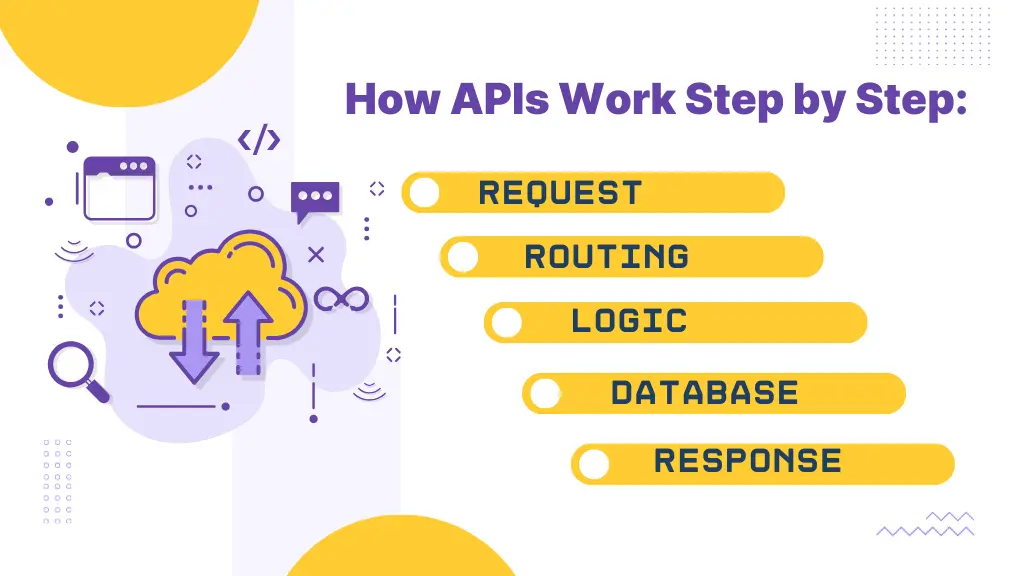
APIs are a core part of backend and full stack development, yet they’re often misunderstood by beginners. Many learners can use APIs but struggle to explain what actually happens after an API call is made.Understanding the internal flow of APIs helps you:
- Debug backend issues more efficiently
- Write cleaner, well-structured code
- Answer interview questions with confidence
- Build scalable, real-world applications
What Is an API (Simple Explanation)
An API (Application Programming Interface) allows different systems to communicate with each other.In a typical web application:- The frontend sends a request
- The backend API processes it
- The database stores or retrieves data
- The API sends a response back
- You place an order → request
- The kitchen prepares it → logic + database
- The waiter serves it → response
Step 1: Sending the API Request
Everything begins when a client (browser, mobile app, or another server) sends a request to the backend.What a Request Includes
- HTTP method (GET, POST, PUT, DELETE)
- Endpoint (/api/login, /api/users)
- Headers (authorization, content type)
- Body (data sent to the server, usually JSON)
Step 2: Routing the Request
Once the request reaches the server, the backend must decide where it should go.What Routing Does
Routing connects:- An HTTP method
- A URL path
- POST /login → login handler
- GET /users → user list handler
Common Beginner Mistake
Beginners often:- Write logic directly inside routes
- Treat routes as controllers
Step 3: Authentication and Validation
Before processing the request, the backend performs safety checks.Authentication Checks
- Is the user logged in?
- Is the token valid and unexpired?
Validation Checks
- Are required fields present?
- Is the data format correct?
- Are values within allowed limits?
- Security vulnerabilities
- Invalid database records
- Application crashes
Step 4: Business Logic Execution
This is the decision-making layer of the API.Business Logic Handles:
- Rules and conditions
- Permissions
- Data processing
- Checking if a user already exists
- Calculating totals or discounts
- Restricting access to certain data
Step 5: Database Interaction
If data needs to be stored or retrieved, the backend communicates with the database.What Happens Here
- Queries are executed (SELECT, INSERT, UPDATE, DELETE)
- Data is fetched or saved
- Results are returned to the logic layer
Important Rule
The frontend never communicates directly with the database.Common Beginner Issues
- Fetching unnecessary data
- Running queries inside loops
- Poorly designed tables
Step 6: Creating the API Response
After logic and database operations are complete, the backend prepares a response.A Response Typically Includes:
- HTTP status code (200, 400, 401, 500)
- Message
- Data (if applicable)
Step 7: Sending the Response to the Client
The backend sends the response back to the client, where:- The frontend reads the status
- Displays messages or data
- Updates the UI
Complete API Flow (Quick Summary)
- Client sends request
- Backend receives request
- Router matches endpoint
- Authentication and validation run
- Business logic executes
- Database is accessed
- Response is created
- Response is returned
Why Beginners Struggle With APIs
Most confusion happens because learners:- Jump straight into frameworks
- Copy code without understanding flow
- Don’t visualize the request lifecycle
How to Practice and Improve API Skills
- Trace one request from start to finish
- Add logs at each step
- Practice explaining API flow out loud
- Build small APIs from scratch
- Focus on fundamentals over tools
Final Thoughts
APIs are not just endpoints—they are structured processes. When you understand how requests move through routing, validation, logic, databases, and responses, backend development becomes far more intuitive.Master the flow, and APIs will stop feeling like magic—they’ll start making sense.Take the Next Step in Backend & API Mastery
If you want to build strong backend and API skills that align with real industry requirements, ITView offers practical, hands-on training programs focused on backend development, APIs, and databases.Based in Pimpri Chinchwad, ITView provides easy access to quality IT education for learners across Pune.Start your journey toward becoming a confident backend developer—train with ITView today.
FAQs:
Q1. What happens first when an API is called?
The client sends an HTTP request containing the method, endpoint, headers, and optional data
Q2. Why is routing important in APIs?
Routing ensures that each request is handled by the correct backend function without mixing responsibilities.
Q3. Should authentication run before business logic?
Yes. Authentication and validation should always happen before executing any logic or database operations.
Q4. Can the frontend directly access the database?
No. Direct database access from the frontend is unsafe and breaks application security.
Q5. How can I improve my API understanding for interviews?
Practice explaining the full API lifecycle step by step and build small APIs without relying heavily on frameworks.
